Recovery Companion
After surgery, the hard part happens at home.
Guided Hope builds a voice companion that calls patients through the days after an operation, listens to how they are doing, and shows the care team what was said. A phone call, not an app to learn.
Why
Between the discharge sheet and the follow-up visit, nobody is listening.
Questions go unasked.
Patients go home with printed instructions and a number they do not want to bother. Small worries wait for the next appointment.
Problems grow quietly.
Rising pain, new swelling, a wound that looks different. The signs are usually there days before they become a call to the ward or a trip to the emergency department.
Care teams cannot call everyone.
A surgical list runs to hundreds of patients. A daily check-in call for each of them is not something a clinic can staff.
How it works
A call each day. A record the care team can read.
-
1
The companion calls.
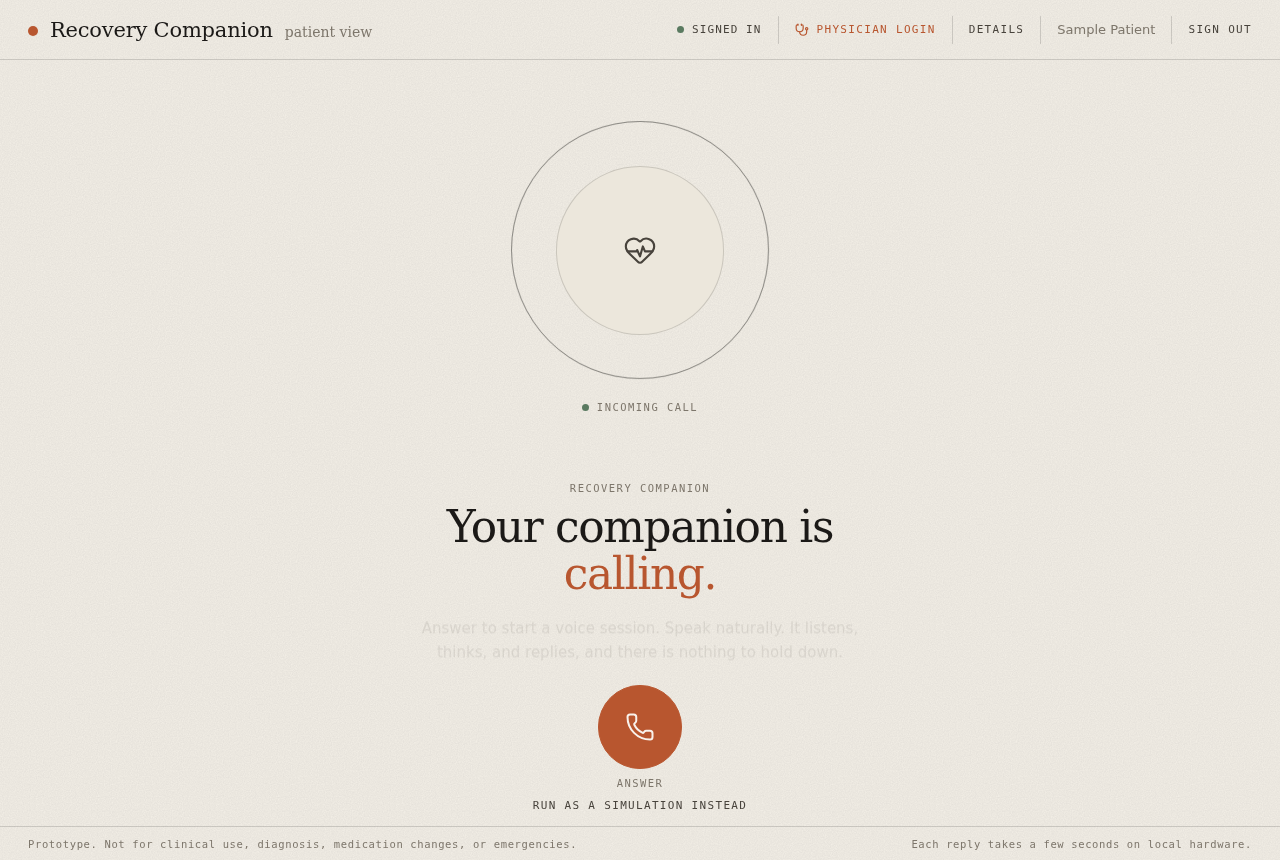
The patient answers in the browser and talks the way they would to a nurse. The companion knows the procedure, the date of surgery, and the care plan, and asks what a follow-up call would ask. Nothing to hold down, and nothing to type unless they prefer to.
-
2
What was said becomes a record.
When the call ends, the pain score, swelling, range of motion, and concerns the patient reported are written down in their own words. Only what they said is kept. A number the patient never mentioned is never invented.
-
3
The care team sees it.
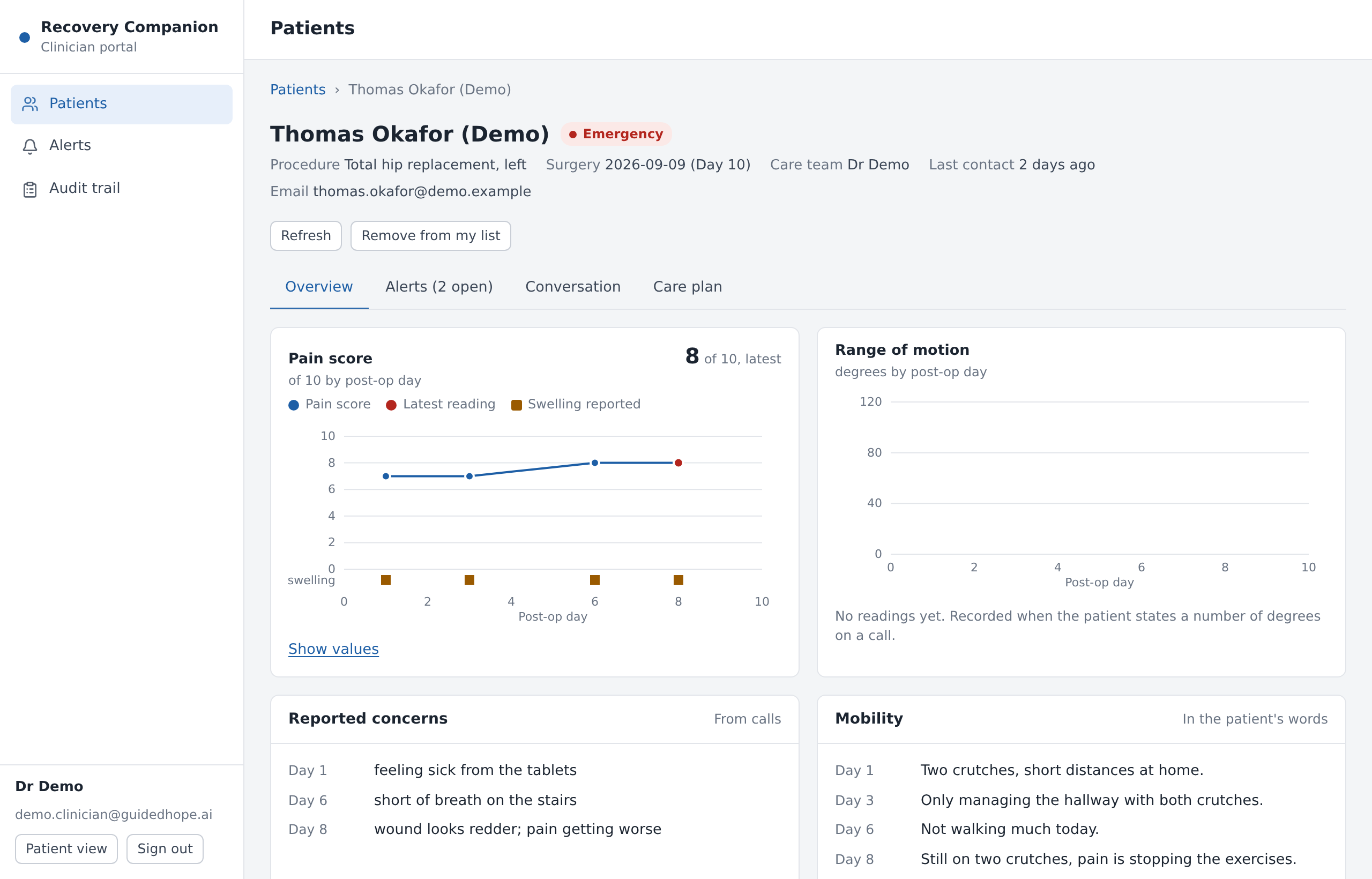
Clinicians open a worklist ordered by who needs attention: trends across the recovery, every flagged message, the full conversation, and a trail of who looked at what.
For clinicians
Familiar on purpose.
The clinician portal is laid out like the worklists a surgical team already uses. Nothing to learn, and nothing decorative in the way.
For the care team
- Add a patient by the email they registered with, and see the same list your colleagues see.
- Alerts for urgent and emergency language, acknowledged and resolved with a note.
- Pain and range of motion over post-op days, with concerns and mobility in the patient's words.
- Every access recorded. The trail keeps no conversation text, so it can be read freely.
For the patient
- Someone checks in every day, at a time that suits them.
- Speak instead of typing. The call listens, thinks, and replies.
- Plain answers about their own care plan, and a clear message when something needs a real person now.
- The names of their care team, and a note that the team can see a summary of each call.
Built carefully
Built for a clinic's rules, not around them.
Safety before the model.
Every message passes a fixed safety check before any model sees it. Urgent and emergency language gets a set response that tells the patient to seek care now, and the care team is alerted.
Nothing leaves without cover.
Patient data reaches a language model only over encrypted transport and only when the endpoint is covered by a business associate agreement. Without both, the system refuses rather than sends. The model can also run entirely on your own hardware.
Separate by design.
Accounts and patient information live in separate databases. Clinicians see only the patients assigned to them, and a patient's sign-in is never a clinician's.
Contact
Talk to us.
We are a small team building this with clinicians. If you run a surgical service and want to see the companion with demo patients, write to us.